Black Mirror #24. Russia’s newest miltech — Arbalet, Dvina-100M, Lev-18, Orbita, Finka and more
Review of new Russian military technology developments for the second week of September
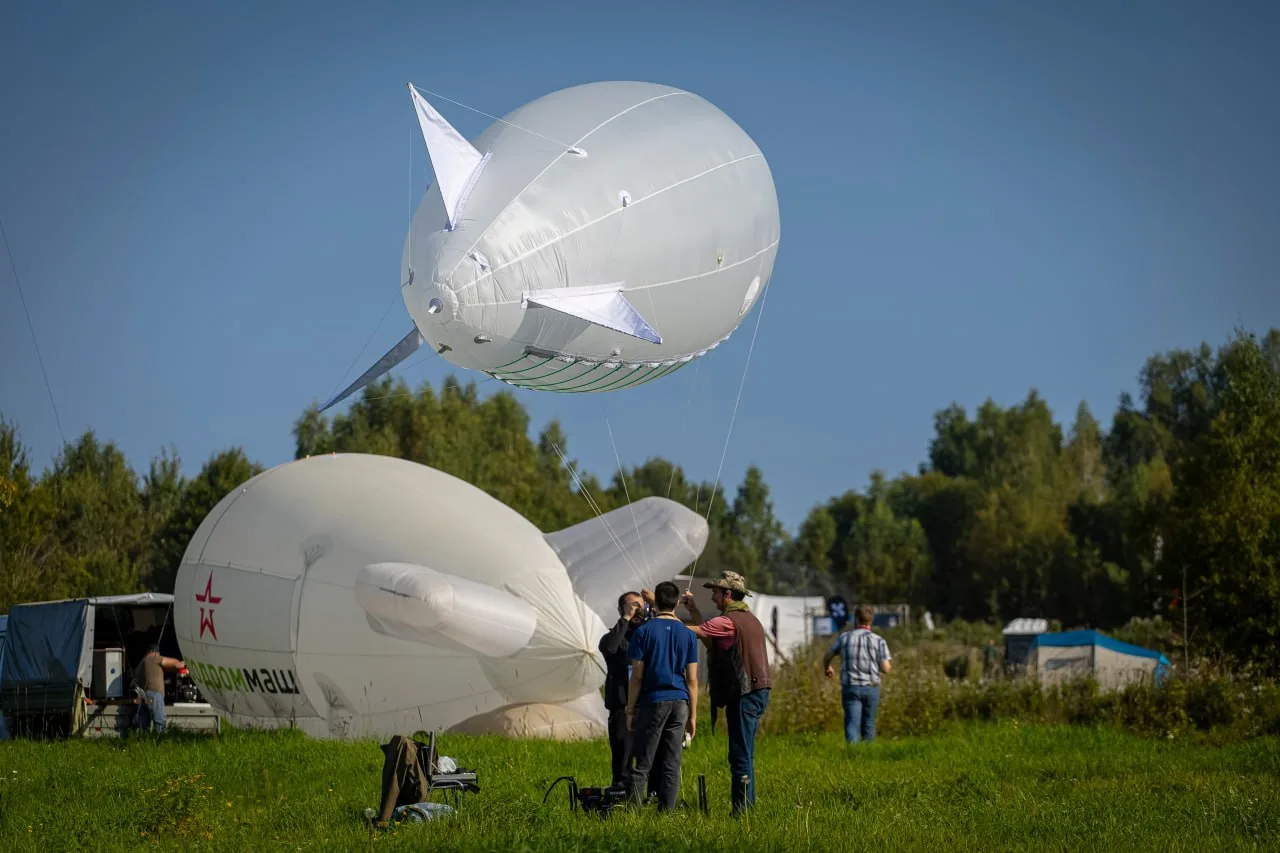
Image Credits: Dronnitsa 2025 / Media here and below from the Internet
Russia does not stop increasing its military-industrial potential. This week, the enemy demonstrated a number of new developments that seek to strengthen its military capabilities, particularly at specialised exhibitions. Among the developments are modernised electronic warfare systems, remote control complexes for drones, new UAVs and unmanned boats.
See details in the new Black Mirror #24.
Supply of electronic warfare systems Dvina-100M
The holding Rosel of the state corporation Rostec has begun supplying the Russian Armed Forces’ electronic warfare units with modernised electronic warfare systems, Dvina-100M. The complex is designed to protect critical infrastructure facilities and industrial enterprises against drones.
Dvina-100M operates in a wide frequency range, including effectively counteracting drones that use pseudo-random tuning of the operating frequency. The device can operate at temperatures from -40 to +50 degrees and form a “protection dome” with a diameter of several hundred meters.
The operating frequency range of the complex varies from 0.1 to 6 GHz. The range in omnidirectional mode reaches 1500 m, in directional mode of up to 2100 m. The mass of the complex reaches 200 kg.
Controlling drones on the front from anywhere in the world
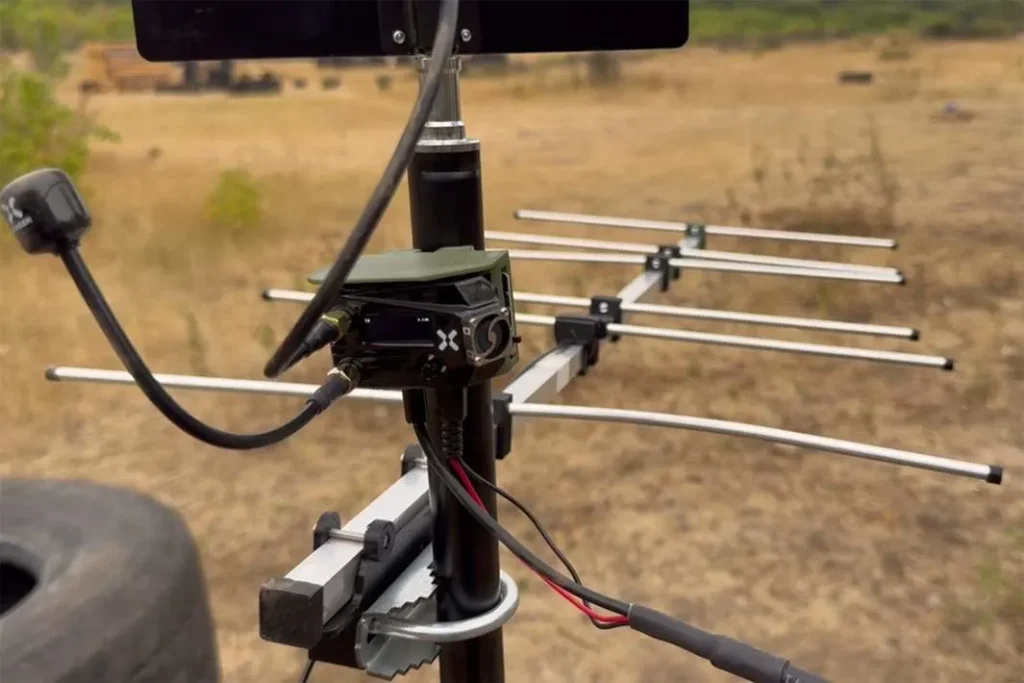
The new remote control system Orbita allows you to control the flight of tactical drones operating on the front line from anywhere in the world. The novelty has already arrived in the Russian army. It has many innovative solutions: for example, neural network algorithms that assist the operator, help stabilise the drone in flight, and find and attack the target.
Experts note that the system performs the work of UAV operators as safely as possible, since they do not need to be in the frontline zone.
Forced drone landing
At the Wings of Sakhalin forum, the Russians tested a drone’s forced landing through a unified identification system based on ERA-GLONASS. The Far Eastern unmanned airline Aurora BAS and GLONASS used the UAV Brazhnik for the test.
The command to stop the flight was transmitted through the module via cellular communication channels. During the tests, scenarios for the drone’s automatic return to the takeoff point and safe landing at a set point were worked out. They are also discussing the format of a “red button,” which will help stop the flight if the drone flies into the zone of a protected object.
Ushkuynik developed a fibre-optic boat
An unmanned boat equipped with a fibre-optic control system is currently undergoing testing in the Black Sea Fleet. Combat tests will take place in September.
Due to its gravity and protected design, the boat is controlled via a fibre-optic cable, which immediately sinks and lies on the bottom. The boat can be used as a kamikaze, a fighter of enemy unmanned boats or an aircraft carrier for FPV drones.
Drones are launched from the side of the boat and controlled by radio, and the fibre-optic channel provides reliable communication with operators on land. The project was created considering the specifics of combat operations in the Black Sea.
New products at the Dronnitsa exhibition
The fourth All-Russian meeting of operators of combat unmanned systems, Dronnitsa 2025, took place. Russians traditionally presented new products on the market. Here are some of them:
- Adel Aero demonstrated Adelix-10 – a vertical take-off and landing drone initially positioned as “affordable VTOL for hobbies and training”. But, according to experts, it can also be used in the military sphere.
- The company Antigravitatsiya showed Finka – a loitering munition with foam wings and a homing function. The product has a cruising speed of up to 110 km/h, and the drone allows you to hit targets at a distance of up to 25 km. The company also brought a Russian analogue of the Baba Yaga hexacopter, which can carry up to 80 kg of payload and reach speeds of up to 70 km/h. They say that it was created almost entirely from Russian components.

- The company Resurs demonstrated a drone called Alexander Nevsky. It can carry a 100 kg payload and, with a load of 50 kg, cover a flight range of 20-25 km. The company has also developed a mini-hexacopter Lev 18 with a propeller span of 18 inches. It can carry one TM-62 mine, one 120 mm mortar mine, or five 82 mm mortar mines. For all options, drop systems have already been developed and printed on a 3D printer.
- NPO Nebo has developed a multi-purpose universal octocopter that leaves the EW zone independently. At 3 kg, the drone can lift up to 15.5 kg, transport a load weighing 10 kg for 10 km, and return to the take-off site.
- NPO Kaysant presented an interceptor drone that accelerates to 380 km/h. The drone, which can be launched from a compact tube, can rise to a height of up to 3 km and cover distances of up to 10 km. Their team also showed a new FPV drone, Artemis 10. The device’s main feature is its launch from a mobile droneport and the possibility of group control from one remote control, thanks to the machine vision system. The drone weighs 1.2 kg, and the target acquisition range is 500 m.
What Russian interceptor drones are targeting Ukrainian UAVs
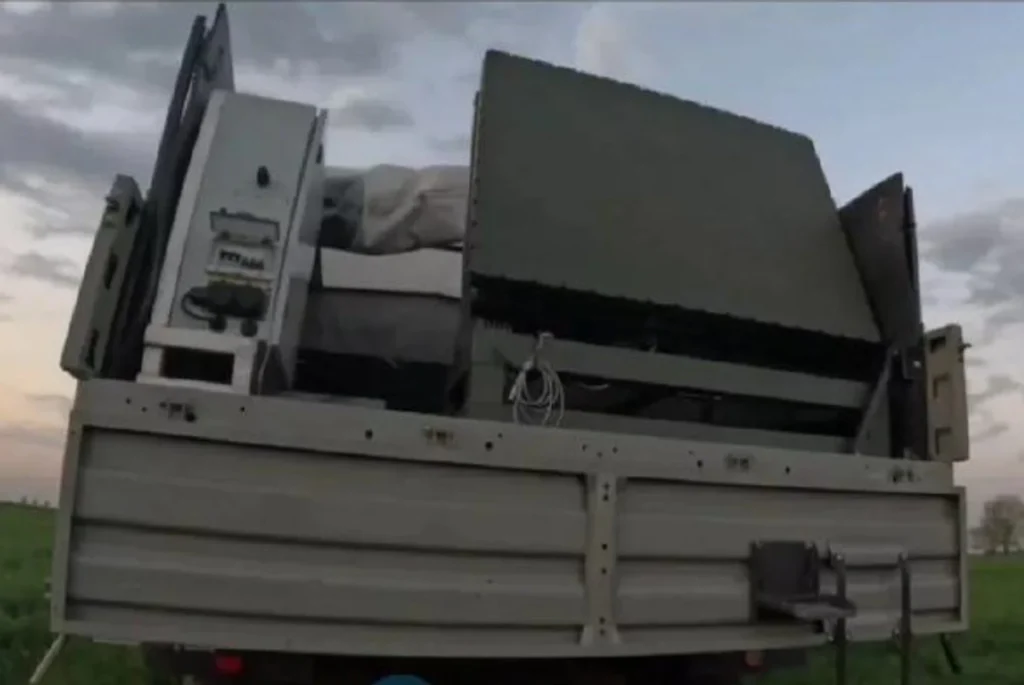
Russian units hunt Ukrainian reconnaissance wings, attack wings and rotary-type bombers only thanks to a network of radar stations. Without them, it is impossible to accurately detect UAVs.
The Russians use both Russian radars, such as Enot and Raduga, and Chinese radars. However, most of their network is built on the SKVP radar. The radar antenna is a flat phased array antenna system measuring 1.2 meters by 1 meter.
The radar consists of:
- RAV radar – airspace surveillance radar station;
- ARM – automated operator’s workplace.
The SKVP radar can detect drones at a distance of up to 20 kilometres. One antenna sees targets in a 90-degree field of view. SKVP can be built with both sector and circular radar detection zones. Four panels in different directions are needed to cover the entire area 360 degrees. Several radars can be interconnected via data transmission channels, giving the operators a global picture of the entire front line.
The radar system can operate from a vehicle body or from the ground. It is most often camouflaged in landings. The radar is usually located no closer than 5-7 km from the front line.
Arbalet — an FPV drone with an AK
Russia has unveiled a multi-role FPV drone fitted with a Kalashnikov assault rifle. Photos of the new system were published by the project Ukraine context | russia no context.
The unmanned aircraft, named Arbalet, is presented as a versatile tool for convoy escort, assaulting positions and even as a short-range air-defence asset. It is built on the 10-inch Drozd airframe and uses a DeviceF40SD flight controller. Both models are developed and manufactured by Device Consulting in St. Petersburg.
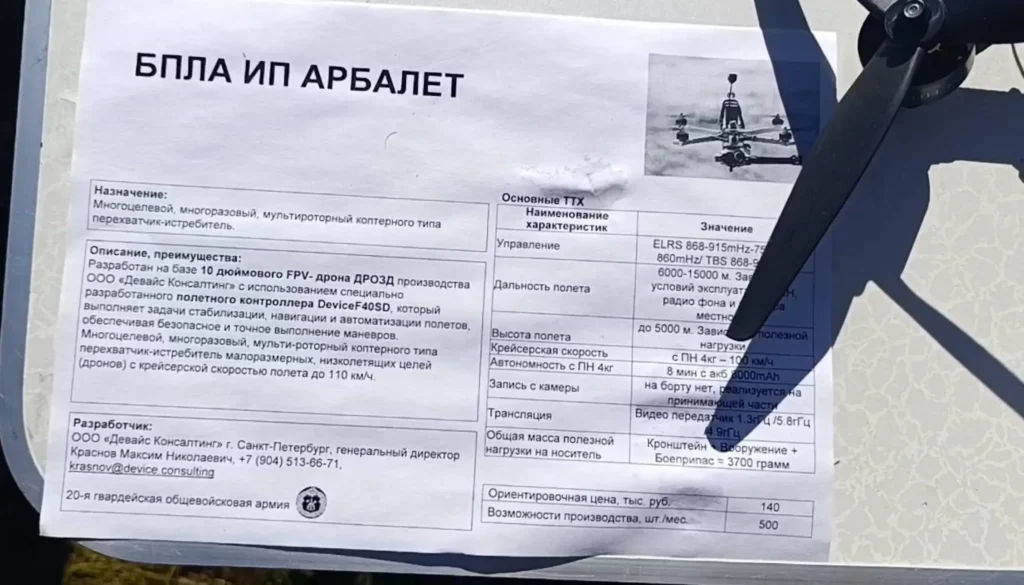
The Arbalet has an operational range of 6–15 km, can climb to 5 km altitude and reach speeds of around 100 km/h, carrying a payload of up to 4 kg. Its armament is an AKS-74U fitted with a 30-round magazine.
By submitting this form, you give Defender Media consent to the processing of personal data.
Надсилаючи цю форму, ви надаєте Defender Media згоду на обробку персональних даних.
Latest news
1

Volodymyr Zinovskyi has replaced TAF Industries founder Oleksandr Yakovenko as the company’s CEO
2
Skyeton unveils a version of Raybird UAV with a hydrogen-powered electric motor
3
The Ukrainian Council of Defence Industry launches the UCDI Investor Club. Its first project is a Ukrainian defence tech dealbook
4
Ukrainian CHUMA fibre-optic drones debut on Brave1 Market — carry up to 4 kg
5