Ratel founder Taras Ostapchuk: in one year, the company has increased UGV production almost fivefold
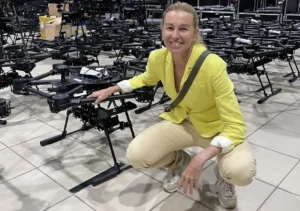
The Land Forces published a report from the workshops where Ratel is manufactured

Photo by manufacturer
Ukrainian UGV manufacturer Ratel has scaled up its production almost fivefold over the past year. Company founder Taras Ostapchuk revealed this in a factory tour video published on the YouTube channel of Ukraine’s Ground Forces.
According to Ostapchuk, Ratel now serially produces several types of UGVs, including the small kamikaze robot Ratel S, the four-wheeled logistics drone Ratel M, and the logistics-evacuation model Ratel H. Currently, the military’s highest demand is for the logistical M and H models.
Production starts with processing raw materials: sheet metal is laser-cut, bent into the required shapes, and then welded using laser technology. Each part is numbered, allowing quick replacement in combat conditions based on feedback from troops. Machines run up to 15–16 hours a day.
Components are coated with powder paint for internal use and with Raptor protective coating for the more expensive M and H models. Logistics drones are equipped with tow bars for carrying trailers and loads. In the larger workshop, Ratel M drones are assembled: after frames are painted, they are fitted with body panels, heated batteries, and electronics, ensuring durability and sealing.
The soldering workshop produces mainboards and modules, while 3D printers create spare parts for ground stations. Every unit undergoes testing before delivery: each drone covers more than 3 km, all functions are checked, and a test sheet is completed.
The enterprise is self-sufficient, with its own nitrogen plant, generators, and backup power supply. Ratel continually upgrades its drones, improving software, chassis, and replacing imported components with in-house solutions. The Ratel S is already in its seventh iteration, while the M and H models are on their fourth to fifth upgrades.
When purchasing a Ratel system, a unit receives a mast for the ground station, a control console, and a set of five robotic platforms — taking into account the possible loss of machines during a mission.
According to Ostapchuk, cooperation with the state is currently well established. In particular, the government provides a 70% advance payment for the production of orders. Officials are encouraging Ratel to expand production and deliver more systems to the front line.
The company’s immediate plans include automating its production. One of the workshops is already operating with a robot, and if everything goes according to plan, Ostapchuk intends to purchase five more. “My view is that wherever a human can be replaced by a robot, it should be done. This applies both to the rear and to the front line,” says Ostapchuk.
Recently, Major General Andriy Hnatov, Chief of the General Staff of the Armed Forces of Ukraine, stated that every Defence Forces brigade should have a robotic systems company.
By submitting this form, you give Defender Media consent to the processing of personal data.
Надсилаючи цю форму, ви надаєте Defender Media згоду на обробку персональних даних.
Latest news
1
Volodymyr Zinovskyi has replaced TAF Industries founder Oleksandr Yakovenko as the company’s CEO
2
Skyeton unveils a version of Raybird UAV with a hydrogen-powered electric motor
3
The Ukrainian Council of Defence Industry launches the UCDI Investor Club. Its first project is a Ukrainian defence tech dealbook
4
Ukrainian CHUMA fibre-optic drones debut on Brave1 Market — carry up to 4 kg
5