Black Mirror #14. Developments by “Ushkuynik”, “Almaz-Antey”, “Shvabe”, GLONASS, and other Russian miltech updates
A weekly review of new Russian miltech developments – for the first week of July
Source: Internet
Black Mirror – a weekly digest of new Russian military technologies. It’s designed to help Ukrainian defenders and developers better understand current and emerging threats. This issue focuses on GLONASS’s initiative to set anti-hacking standards for drones, a laser-based mine neutralisation system, drones armed with automatic rifles, multimode UAVs, and new methods of “disposing” of drones using a bionic hand.
GLONASS to protect drones from cyber attacks
GLONASS initiated the creation of unified standards for protecting drones from cyber attacks. All because without protection against hacking and interception of control, the mass introduction of drones for delivery, monitoring or warfare is impossible.
The developed standards are initially intended to be extended to civil unmanned aviation, and then to all unmanned transport. The program is planned to be created by the end of 2025.
Drone-interceptor with two shooting complexes
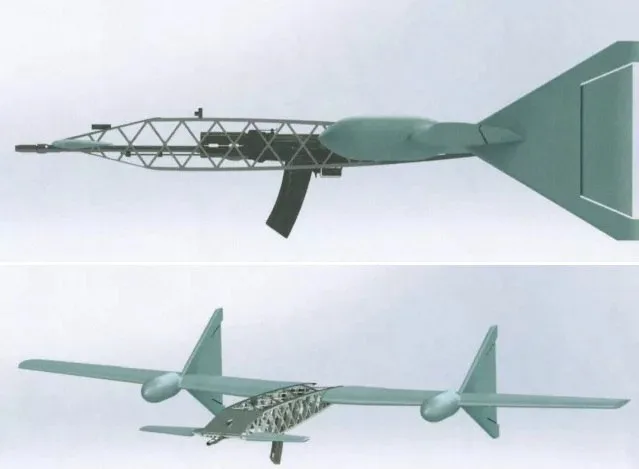
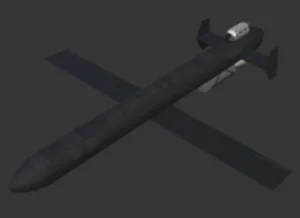
The Almaz-Antey concern has developed an unmanned interceptor, an aircraft-type UAV, equipped with something similar to a carbine or machine gun. The drone is equipped with a computer module that processes and corrects the trajectory, allowing for precise aiming at high speeds.
Information about a similar device has also been reported from the Indian defence company BSS Alliance. It is unclear who spied on whom with the idea, but the Indian device featuring an integrated AK-203 has already been tested by the Indian army.
A UAV with a variable thrust vector
The Azimut Research and Development Center (Rostec) is completing factory tests of its UAV with variable thrust vector. The main characteristic of the drone is the ability to operate in four modes: copter, airplane, helicopter and VTOL.
Expected characteristics:
- take-off weight – 8 kg;
- empty weight – 3.5 kg;
- payload – 3 kg;
- battery weight – 1.5 kg;
- range – up to 15 km;
- speed – up to 150 km/h.
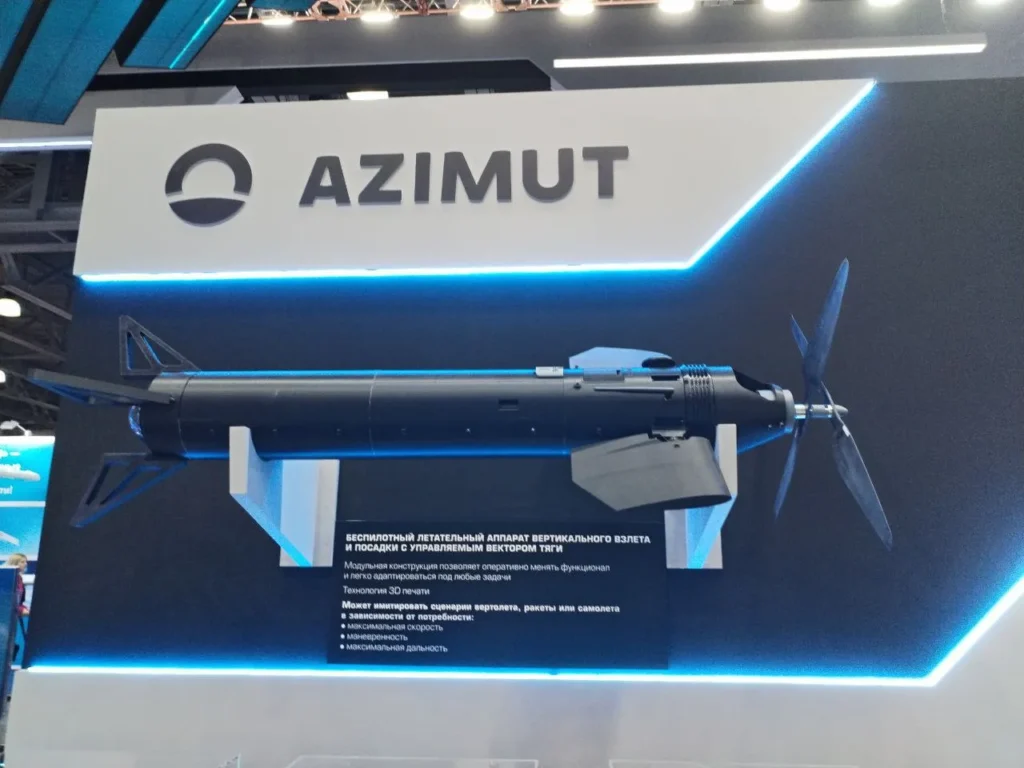
So far, the prototype is at the level of technical readiness of the UGT5, but the cost of the finished device will be from 300 to 500 thousand rubles. At the same time, its fuselage is completely printed on a 3D printer, allowing the device to be adapted to specific tasks.
Robotic laser demining complex
The holding Schwabe (“Rostec”) first presented a prototype of a new robotic laser demining complex during the International Forum “Engineers of the Future”.
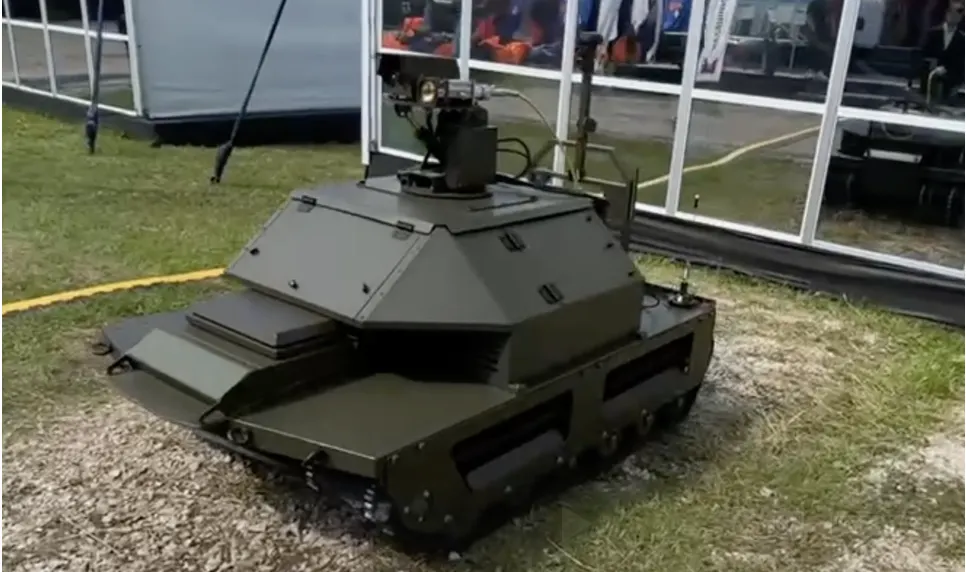
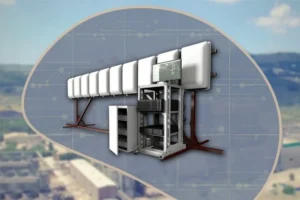
Laser radiation allows you to neutralise unexploded ammunition, mines and improvised explosive devices, including those equipped with non-contact detonation sensors. Decontamination occurs by burning the shell and melting the explosive without detonating it. The product operates on batteries and is remotely controlled by a radio channel or fibre optic. The range reaches several kilometres, which ensures complete safety for the operator.
Air defence system with a combat beam
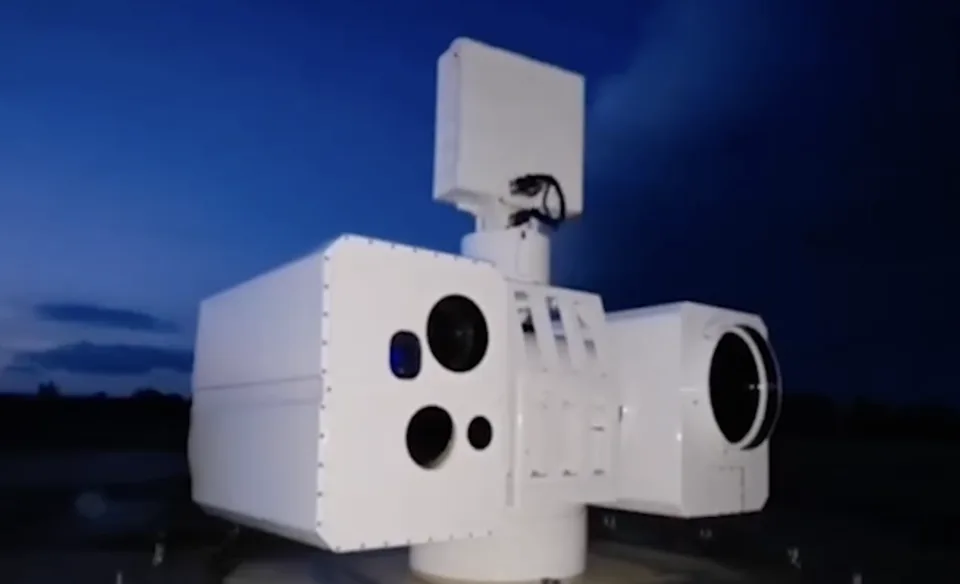
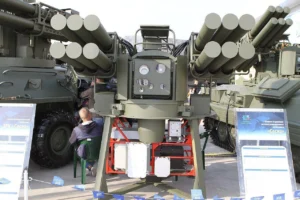
The Russians have begun using a new air defence system with a combat beam – it burns out the cameras of Ukrainian drones and extinguishes them before they even approach.
Small strike UAVs can be eliminated at a distance of 2–3 kilometres, reconnaissance ones – up to 6 kilometres. The principle of operation is quite simple – the laser burns out the camera arrays, which makes it impossible to control the drones. The air defence system has a power of 35 kW.
The cost of deployment is comparable to traditional air defence systems. On the other hand, the operation is cheaper because you don’t need to spend money on missiles. The drawback is that the lasers are ineffective in foggy weather, snow or rain and only work in the visibility zone.
An arm for collecting drones
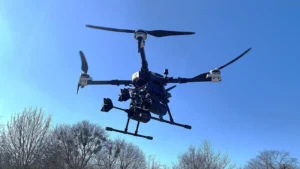
The CEO of the sanctioned Ushkuynyk Research and Development Centre said that the company has developed drones with a mechanical arm to collect downed Ukrainian UAVs. The innovation may allow the Russians to solve two problems at once. One of them is the acute shortage of drones on the front line. The second is the need to safely collect devices that have fallen and are lying in dangerous or mined areas. In the case of a drone with a bionic arm, only a part of it will be lost in an explosion, not the entire drone.
The idea of attaching an arm to a UAV to collect something is not new. Recently, the Chinese showed off a device with a trunk arm designed to inspect hard-to-reach objects, clear debris after natural disasters, and work with damaged infrastructure.
Lyagushka on Shanghai
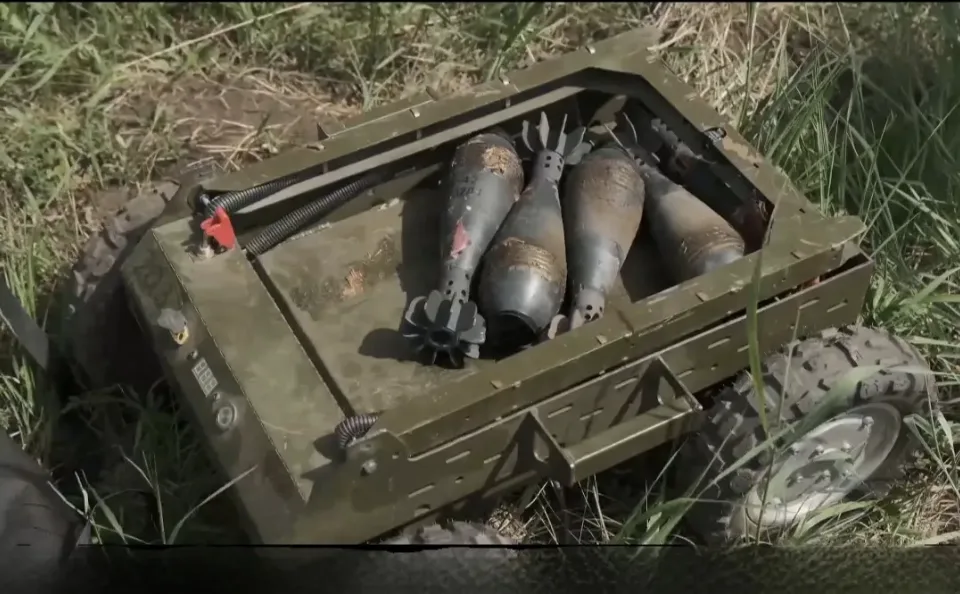
Russians use the ground-based robotic off-road drones Shanghai and Lyagushka (“Frog”) to deliver ammunition and evacuate the wounded. The wheeled drone Lyagushka, placed on a larger and tracked drone Shanghai, allows it to operate at a considerable distance and under difficult conditions, increasing the radius of action of the unit. Ground-based drones can carry up to 200 kilograms, which makes it possible to evacuate two wounded people or transport ammunition.
Paratroopers also use these drones as strike weapons and to transport anti-tank mines.
By submitting this form, you give Defender Media consent to the processing of personal data.
Надсилаючи цю форму, ви надаєте Defender Media згоду на обробку персональних даних.
Latest news
1
Volodymyr Zinovskyi has replaced TAF Industries founder Oleksandr Yakovenko as the company’s CEO
2
Skyeton unveils a version of Raybird UAV with a hydrogen-powered electric motor
3
The Ukrainian Council of Defence Industry launches the UCDI Investor Club. Its first project is a Ukrainian defence tech dealbook
4
Ukrainian CHUMA fibre-optic drones debut on Brave1 Market — carry up to 4 kg
5