Black Mirror #6. UGV ‘Depesha’, KamAZ with two ‘Lancets’, ‘Dobrynya Nikitich’ hybrid drone, and other additions to Russian miltech
What was displayed at the May 9 Parade in Moscow and what hybrid drones are capable of

Image Credits: Internet
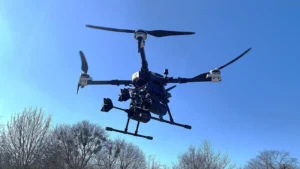
Russia is ramping up the development of unmanned solutions—surface drones, UGVs, and UAVs. New systems are already being delivered to the military or undergoing combat testing. Among this week’s updates, hybrid drones stand out—equipped with both standard communication and a 30 km fiber-optic cable. A new mobile launcher for Lancet loitering munitions was also showcased during the Moscow parade, designed to help Russian forces deploy and launch these drones more quickly.
More details in Black Mirror #6. Defender publishes this roundup of Russian miltech developments to help Ukrainian innovators and their allies stay informed and prepare effective responses.
Russian BEK Katran will become carriers of drones Skvorets-VMF
The Russians are modernising the kamikaze drone Skvorets-VMF (from JSC Technodron) to launch it from the board of the surface drone Katran. The UAVs will be able to operate at a distance of 5-10 km from the boat and be used for reconnaissance and strike purposes.
Skvorets-VMF has a sealed housing that protects the devices from the effects of water and salt. By reducing the payload to 1.5 kg the range has been increased to 10 km. To work with Katran, the device will receive an updated power system with the possibility of recharging from the boat.

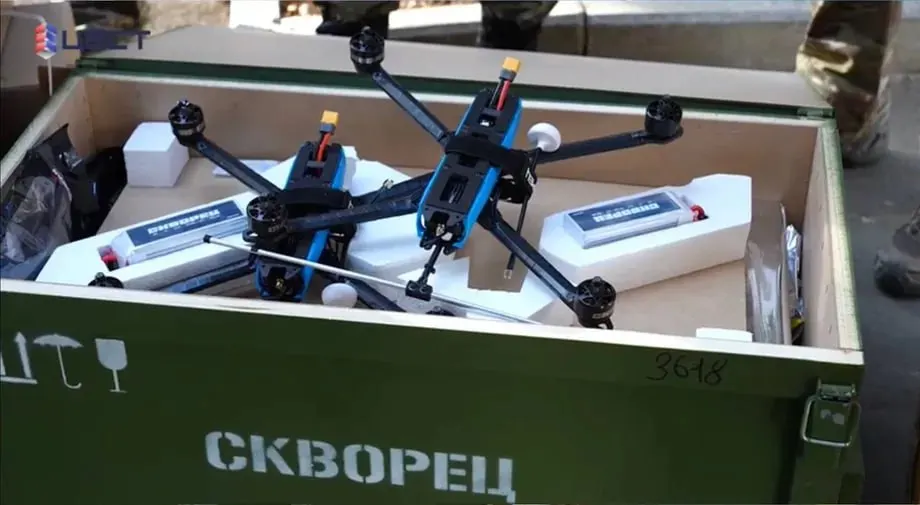
The maximum flight speed reaches 150 km/h. The flight duration in the basic configuration is up to 12 minutes.
Rosteh has delivered a batch of Depesha tracked drones
Rosteh has delivered a batch of Depesha multifunctional UGVs on a tracked chassis to the Russian army. Depesha is capable of speeds up to 15 km/h and can deliver a load weighing 100 kg. The complex is made of light and durable materials, which provides it with manoeuvrability and the ability to overcome various obstacles.
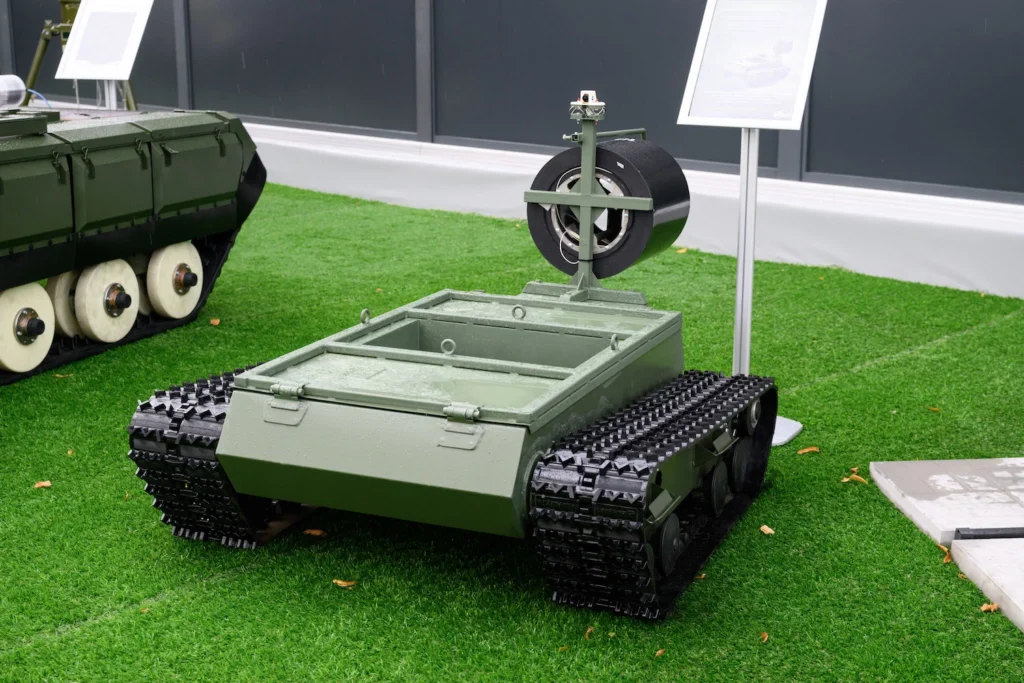
Depesha is controlled using a remote control. Video is received on VR goggles or the operator’s monitor. The platform can be equipped with a wired fibre-optic communication line, while all the main technical characteristics are preserved. Due to its small size, the Depesha can be transported in the trunk of an SUV or pickup truck.
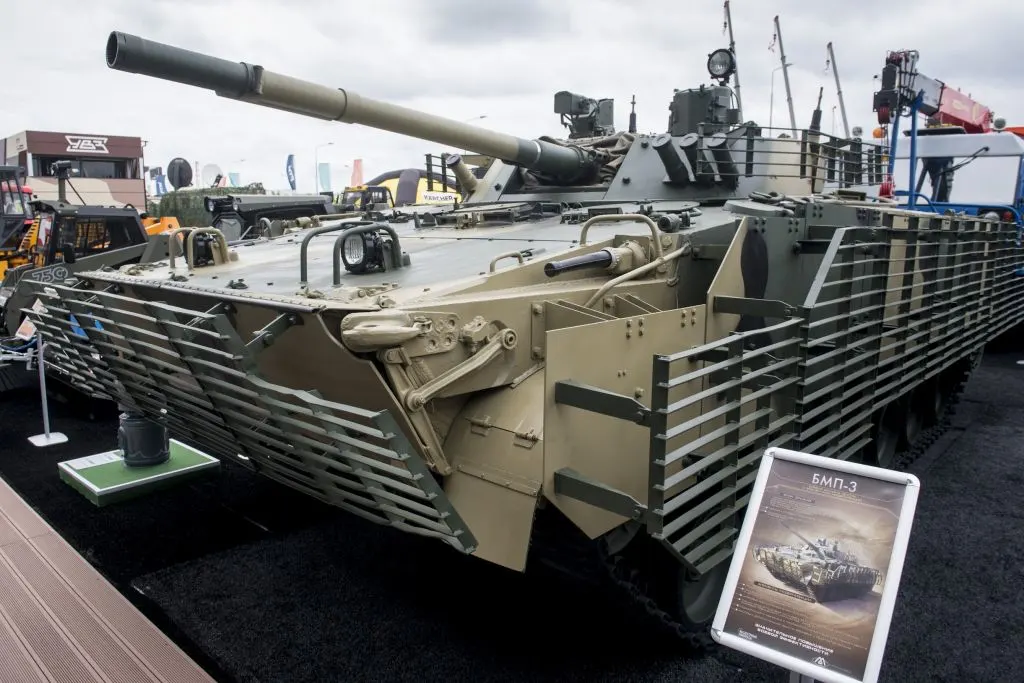
New batch of BMP-3s equipped with electronic warfare
In addition to tracked drones, this week Rostec also delivered a new batch of BMP-3s to the Russian army. It is standardly equipped with anti-cumulative grilles, armour screens, and upper hemisphere protection kits. Each BMP received a “cloak” – a set of means of reducing visibility made of synthetic heat-insulating and radio-absorbing material. In addition, all vehicles are equipped with electronic warfare equipment.
The BMP-3 has proven itself both as an infantry fighting vehicle and as a light tank. The Russians note its high mobility, which helps on difficult terrain and off-road, as well as a powerful 100-millimeter cannon, which allows it to hit any targets on the battlefield. With a full set of additional protection, the BMP-3 retains its high mobility, and its survivability increases many times over.
Hybrid fiber-optic drones
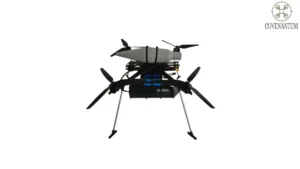
Russians are actively fighting fibre-optic breaks on drones. The Frobotics Engineering Centre for Advanced Developments has begun to produce a configuration of drones Svarog 15, Gruzovichok and Dobrynya Nikitich on domestic fibre-optic and with a communication duplication system. That is, in the event of a fibre-optic break, drone control automatically switches to the radio channel.
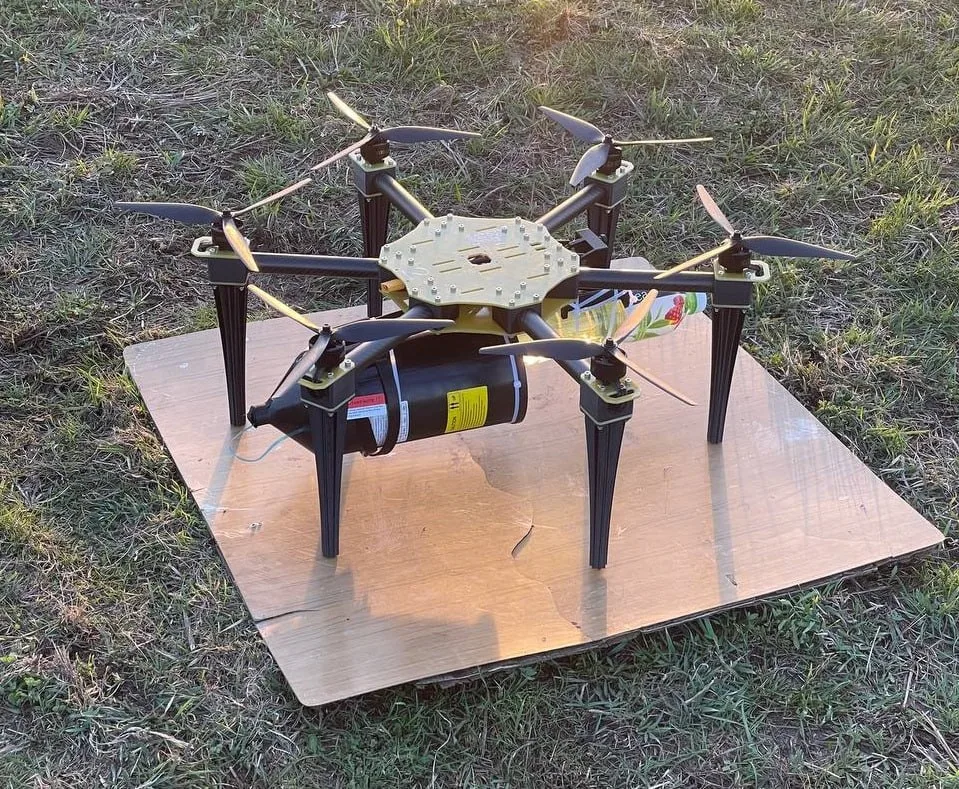
On fibre-optic devices, they can be used at distances of up to 30 km. In addition, Russian units have begun to be supplied with cargo drones Svarog 15 with a payload of 14 kg and 30 kg, which solve supply tasks and work without the use of GPS.
Flight controller for FPV drones MPK-8
Fly Tech recently introduced one of the first Russian flight controllers MPK-8 for FPV drones. This development will reduce dependence on foreign supplies and technologies and adapt the device to the needs of the Russian military.
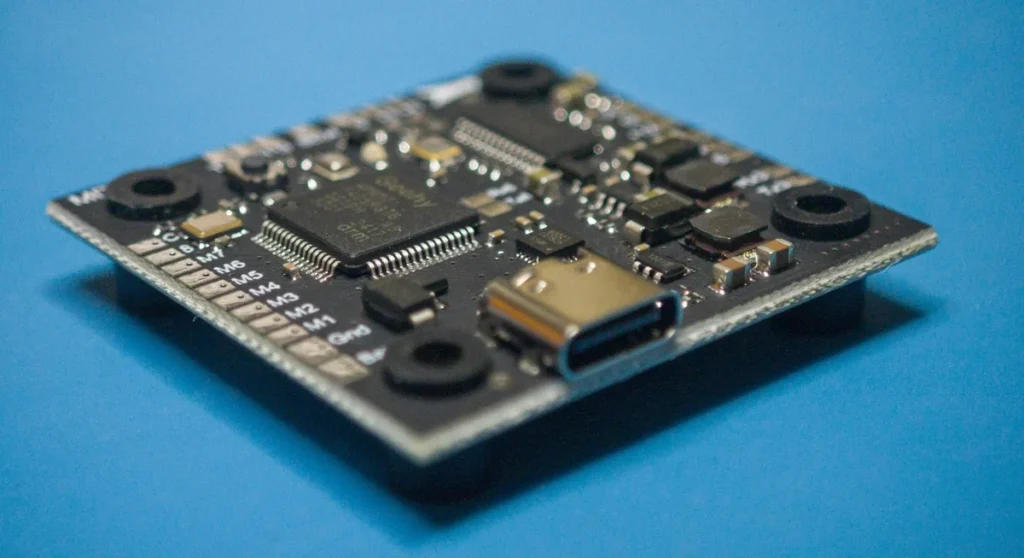
MPK-8 is assembled on modern SMD assembly lines in Perm. The device is equipped with a Cortex-M4 processor. The OSD chip overlays useful data and flight parameters on the video transmitted from the FPV drone camera. Among the information displayed are the supply voltage, current consumption, time since takeoff and other important indicators. Outputs for motors and servos support connection to up to 8 devices and work with Dshot, Oneshot and Multishot protocols. This provides flexibility in configuring and controlling the drone. The USB Type-C connector allows you to directly connect to a computer to configure and test the controller.
The flight controller is equipped with a gyroscope/accelerometer and a barometer, which ensures stability and control accuracy. The UART interfaces allow you to connect up to 3 additional devices and support PPM Receivers and Serial Receivers control systems.
The MPK-8 module has compact dimensions – 40 mm × 40 mm, with 4 × 30 mm mounting holes. This allows it to be easily installed in most modern drone frames.
Russia has begun testing a silent military tow truck
The Horizon Design Bureau has designed and built a silent version of a small army tow truck, which will soon go to the front in Ukraine for testing in real conditions.
With the help of such a two-wheeled electric tow truck, you can covertly transport the wounded to rear medical facilities, as well as deliver ammunition. Moreover, it can move in areas where it is difficult for a car or ATV to get there.
The development is equipped with a special trailer and is practically silent and invisible in a thermal imager. Its speed can reach 40 km/h.
Gardar – a new radar for detecting UAVs
Novgorod State University has created a new radar for detecting drones called Gardar. The development is a small-sized device weighing no more than 7-8 kg, which outwardly resembles a miniature mobile base station. Using active radar technology, it can detect UAVs, unmanned boats and other moving targets within a radius of about 3 km. A large number of devices of the same type will be combined into a network and form a continuous radar coverage.
After detecting an object, the radar transmits the target designation to the operator or decision-making system. Inside, algorithms for generating and processing signals are implemented, which allow, using weak signals, to “see” as far as analogues with powerful radiation.
The Gardar’s radiation power is comparable to that of a regular mobile phone, making it safe to deploy even in crowded areas.
Mobile Lancet drone launcher
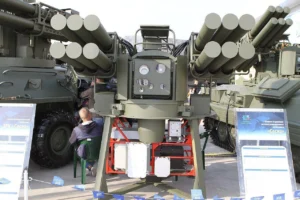
At a May 9 parade in Moscow, the Russians unveiled a new mobile Lancet drone launcher based on a KamAZ 8×8 truck, demonstrating the integration of drones into tactical operations.
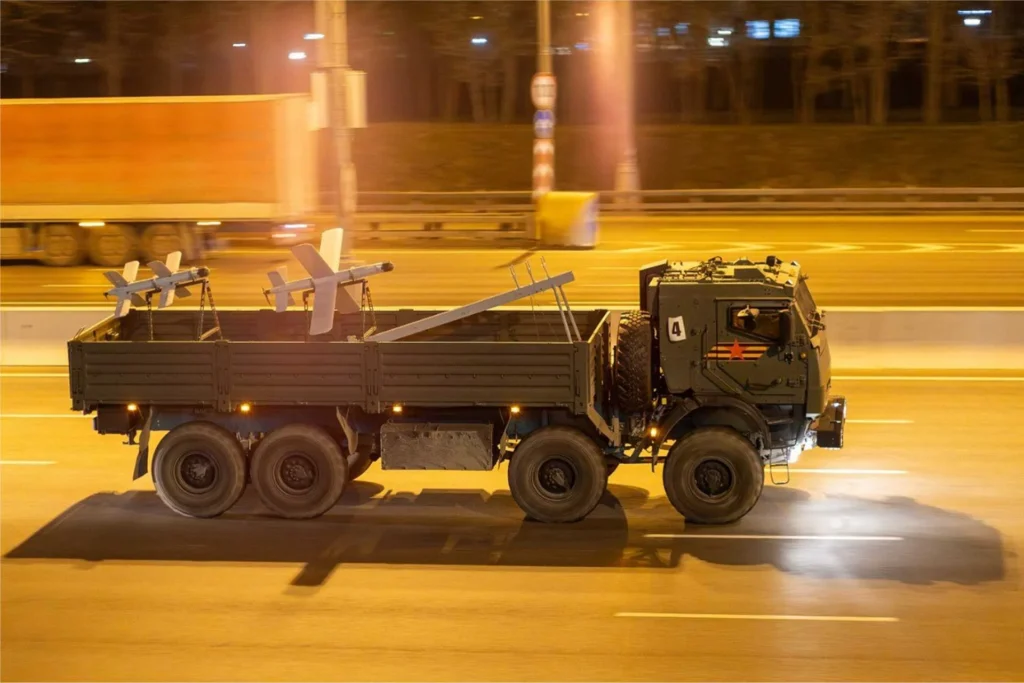
The platform was first shown at a parade rehearsal in April. According to an analysis by Army Recognition’s editorial team, the heavy Kamaz chassis carries two Lancet loitering munitions, located alongside a single launcher integrated into the rear of the truck. This configuration will provide Russian forces with a highly maneuverable platform capable of launching and withdrawing missions with minimal preparation time.
By submitting this form, you give Defender Media consent to the processing of personal data.
Надсилаючи цю форму, ви надаєте Defender Media згоду на обробку персональних даних.
Latest news
1

Volodymyr Zinovskyi has replaced TAF Industries founder Oleksandr Yakovenko as the company’s CEO
2
Skyeton unveils a version of Raybird UAV with a hydrogen-powered electric motor
3
The Ukrainian Council of Defence Industry launches the UCDI Investor Club. Its first project is a Ukrainian defence tech dealbook
4
Ukrainian CHUMA fibre-optic drones debut on Brave1 Market — carry up to 4 kg
5